

In 1980, H.H. Dudjom Rinpoche, Jigdral Yeshe Dorje, was invited by Ven. Gyatrul Rinpoche to bless the mountain valley retreat land that was to become Tashi Chöling. On this visit, His Holiness recognized that the site possessed auspicious signs for a place of practice, proclaimed it to be the Copper-Colored Mountain of Guru Rinpoche and made the prayer that all who practice there with sincerity would attain the rainbow body. His Holiness encouraged everyone to work together to create a traditional Tibetan Buddhist retreat center and stated with conviction that this would bring benefit to all sentient beings.
In the decades that followed, Ven. Gyatrul Rinpoche and Sangye Khandro devoted themselves tirelessly to building and developing the center—working alongside volunteers, raising funds, giving teachings, leading retreats, translating sacred texts and hosting great lamas. Their extraordinary efforts, along with those of many devoted volunteers, laid the foundation so that the dharma might flourish continuously in this land. Thus, the splendid place of refuge that is Tashi Choling was fully established.
Wisdom takes Form as Tashi Choling
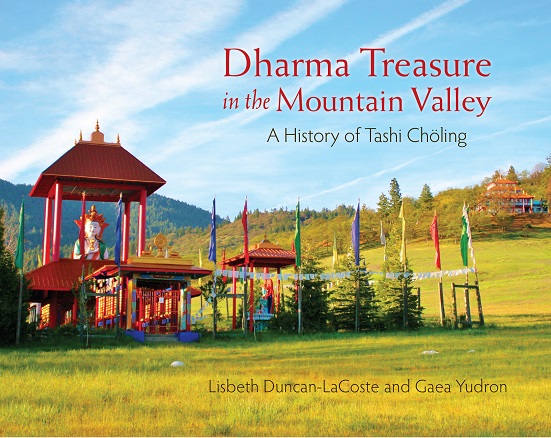
The first project on this wild and remote land, started in the summer of 1982, was the creation of a 34-foot high statue of the peaceful buddha of purity, Buddha Vajrasattva. Surrounded by expansive vistas of the dynamic skies and snow-tipped mountains, in a valley of wildflowers and feathery grasses, the exquisite statue came together “as if building itself,” as Rinpoche later described it, with volunteers and supplies showing up in perfect timing for each stage. Once the main statue was finished and painted, students set about creating a sacred mandala landscape of colorful plants and flowers and laid paths for circumambulation around the statue.
Following this, in 1985, work began on the main temple. Its site was chosen upon the picturesque hill above the meadow where the statue garden was nestled. The structure evolved into an elegant four-story traditional temple replete with an ornate and vibrant shrine room.
Once the temple was complete, work commenced on an adjacent wing to accommodate visiting lamas, guests, practitioners and group retreats. Throughout each stage of Tashi Choling’s construction, students have arrived in a continuous stream, gathering to engage in study and practice, attend retreats, learn Tibetan language and artistic skills and develop their lives in harmony with the dharma. As students worked together, Rinpoche constantly emphasized and illuminated the inner spiritual significance and effects of their activity, which were to remove obstacles to their spiritual development and to accumulate wisdom merit.
Gradually, more areas of the land were developed into resplendent meditation gardens replete with ponds, pagodas and hand painted frescoes, rows of prayer wheels and other artistically embellished shrines adorned with beautiful offerings. These glorious shrines hold representations of the enlightened qualities of body, speech and mind, including revered statues of female buddha emanations such as Tara and Yeshe Tsogyal. Positioned according to principles of sacred geography, they were placed in forests, along streams and on hilltop vistas. Their sacred contents were uniquely crafted by skilled traditional artisans with student volunteers working alongside as apprentices. During this process, in concert with Rinpoche’s Bay Area center in California as well as the greater worldwide sangha, an archive, publishing house, printery of traditional Tibetan texts and a translation group were also established, today known as Vimala.
Throughout Tashi Choling’s history, Ven. Gyatrul Rinpoche continually invited the greatest masters of our time to visit, transmit dharma and consecrate the shrines as a treasure of blessings for future generations to come—masters such as Kyabje Dudjom Rinpoche Jigdral Yeshe Dorje, H.H. Penor Rinpoche, H.H. Jigme Phuntsok Rinpoche, H.H. Dodrupchen Rinpoche and Ven. Yangthang Tulku Rinpoche. As a result, the entire land is filled with the tangible presence of these blessings, always inviting connection with the wisdom mind of the Buddha.
Tashi Choling’s outer form is the temple, the inner form is the sangha, the secret aspect is meditation, and the supremely secret aspect is liberation itself. According to our abilities, we have built a place of refuge in which to practice Dharma so that our body, speech and mind can make a connection on an inner level which leads to true understanding of the symbolic representation. Life is short, and in this temporary situation one can learn, practice and purify obscurations to spiritual development. In the future, if one has applied these methods, one will be led to liberation from all suffering. This is the aspiration of the Buddha.
~ Ven. Gyatrul Rinpoche